

Brussels, 15 December 2025
Protection International (PI) is a global human rights organisation that works alongside human rights defenders (HRDs) to ensure the right to defend human rights for all, grounded in international human rights law, the UN Declaration on Human Rights Defenders, and PI’s Global Strategy Framework 2024–2028, which prioritises the creation of enabling environments for human rights defenders (HRDs) and their collectives.
Thailand: Political Transition and Heightened Risk
Thailand is entering a decisive political moment. The dissolution of Parliament on 11 December 2025 has triggered a new electoral process under a caretaker administration, alongside growing public demand for constitutional reform. This moment raises fundamental questions of democratic legitimacy, public participation, and state compliance with international human rights obligations.
With a general election confirmed for 8 February 2026, uncertainty persists regarding whether this process will involve only an election, an election combined with a constitutional referendum, or further delays. Such uncertainty predictably heightens risks for HRDs, particularly those advocating for constitutional reform, democratic participation, land and environmental justice, labour rights, and gender equity (1).
This transition is unfolding within the framework of the 2017 Constitution, which has been criticised for limiting inclusive public participation and democratic accountability. Simultaneously, security-based narratives – often linked to border tensions and national stability – are increasingly being deployed to justify restrictions on peaceful assembly, freedom of expression, and human rights work.
Human Rights Defenders are the Backbone of Democracy
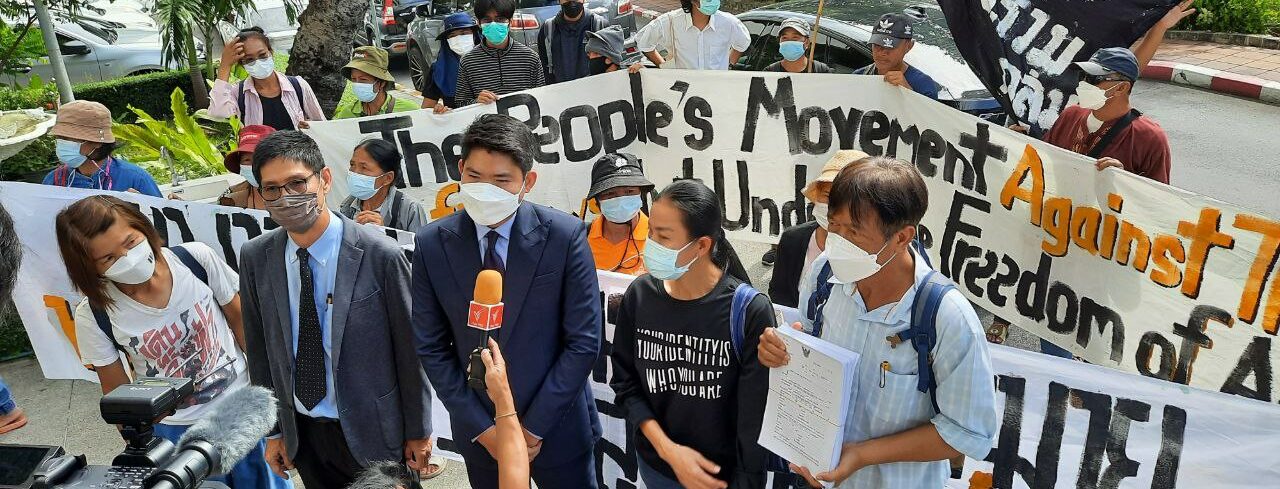
In this context, Protection International accompanied the Thai NGO Coordinating Committee on Development (NGO-COD) and more than 1,000 women and HRDs during the Walk for the Future, a peaceful five-day mobilisation calling for:
- A new constitution drafted in its entirety, and
- A 100% elected Constitution Drafting Assembly.
This mobilisation demonstrates that demands for constitutional reform are broad-based, legitimate, and rooted in lived realities. Women HRDs, community leaders, farmers, workers, and grassroots movements are the pillars of a safe, peaceful and prosperous society – they are rights-holders exercising their internationally protected rights to peaceful assembly, participation in public affairs, and the defence of human rights.
As Pranom Somwong (Bee), Protection International’s Country Representative in Thailand, states:
“A constitution written without the people cannot deliver democracy. And people cannot participate without the right to defend human rights. The protection of human rights defenders is therefore not optional – it is a precondition for legitimate political transition.”
Criminalisation, Stigmatisation, and Judicial Harassment
International experience shows that political transitions are often marked not by overt repression but by systematic control through law, surveillance, and stigmatisation. In keeping with the genuine spirit of democracy, transitions to new elections should allow social demands – such as the call for a new democratic constitution and more – to be addressed through peaceful means. Instead, what we are seeing is judicial harassment and strategic lawsuits against public participation (SLAPPs), digital repression and gendered online attacks, restrictions on peaceful assembly, and the criminalisation of solidarity against HRDs and citizens. Defenders are wrongly being portrayed as threats to security or national unity.
These practices violate the state’s obligation to respect, protect, and fulfil the right to defend human rights, and directly undermine democratic participation, the rule of law, and social peace.
Calls to All Duty-Bearers and Stakeholders
Protection International calls on all duty-bearers and stakeholders to uphold the right to defend human rights at all times, including during elections and constitutional processes. States must end the criminalisation and judicial harassment of human rights defenders, repeal laws used to silence peaceful dissent, and adopt effective safeguards against SLAPPs.
Women HRDs and marginalised groups must be protected from gendered and intersectional violence and recognised as legitimate political actors, not security threats. An enabling environment for democratic participation must be guaranteed, ensuring safe, inclusive, and meaningful public engagement free from fear and repression.
Sustained, flexible support for legal defence, psychosocial care, and collective protection is essential to enable defenders and their movements to continue their work safely and effectively.
The EU–Thailand Human Rights Dialogue on 16 December 2025 takes place at a moment of acute political risk in Thailand. This meeting must directly challenge the repression of HRDs and the erosion of civic space. Human rights cannot be sidelined in EU–Thailand relations.
We therefore call on the European Union, consistent with the EU Guidelines on Human Rights Defenders, to support Thailand in strengthening the protection of human rights defenders, ending criminalisation and judicial harassment, and creating an enabling environment for the right to defend human rights.
More specifically, Protection International calls on the EU to:
- Assert the non-negotiable nature of the right to defend human rights
Assert that repression, criminalisation, and fear negate the democratic legitimacy of Thailand’s political and constitutional process. - Uphold human rights standards in all EU-Thailand relations
Integrate concrete and measurable human rights benchmarks – particularly on HRD protection, SLAPPs, and civic space – into all EU–Thailand engagements, including trade and investment discussions. - Act preventively, not reactively
Engage early, publicly, and decisively when risks emerge, rather than responding only after violations occur. This includes conducting trial observation and political monitoring in emblematic cases involving HRDs. - Support structural change, not symbolic reform
Insist that democratic constitutional reform requires a fully elected drafting body and meaningful, inclusive public participation.
“The right of human rights defenders and grassroots movements to protect human rights, along with their associated protection networks, must be safeguarded. They are essential pillars of any vibrant democracy.”
Mauricio Angel, Head of Policy, Research, Advocacy and Training at Protection International
1: For more on upholding the right to defend human rights during democratic elections, see Protection International’s 2022 statement.
Download the statement in PDF format here.