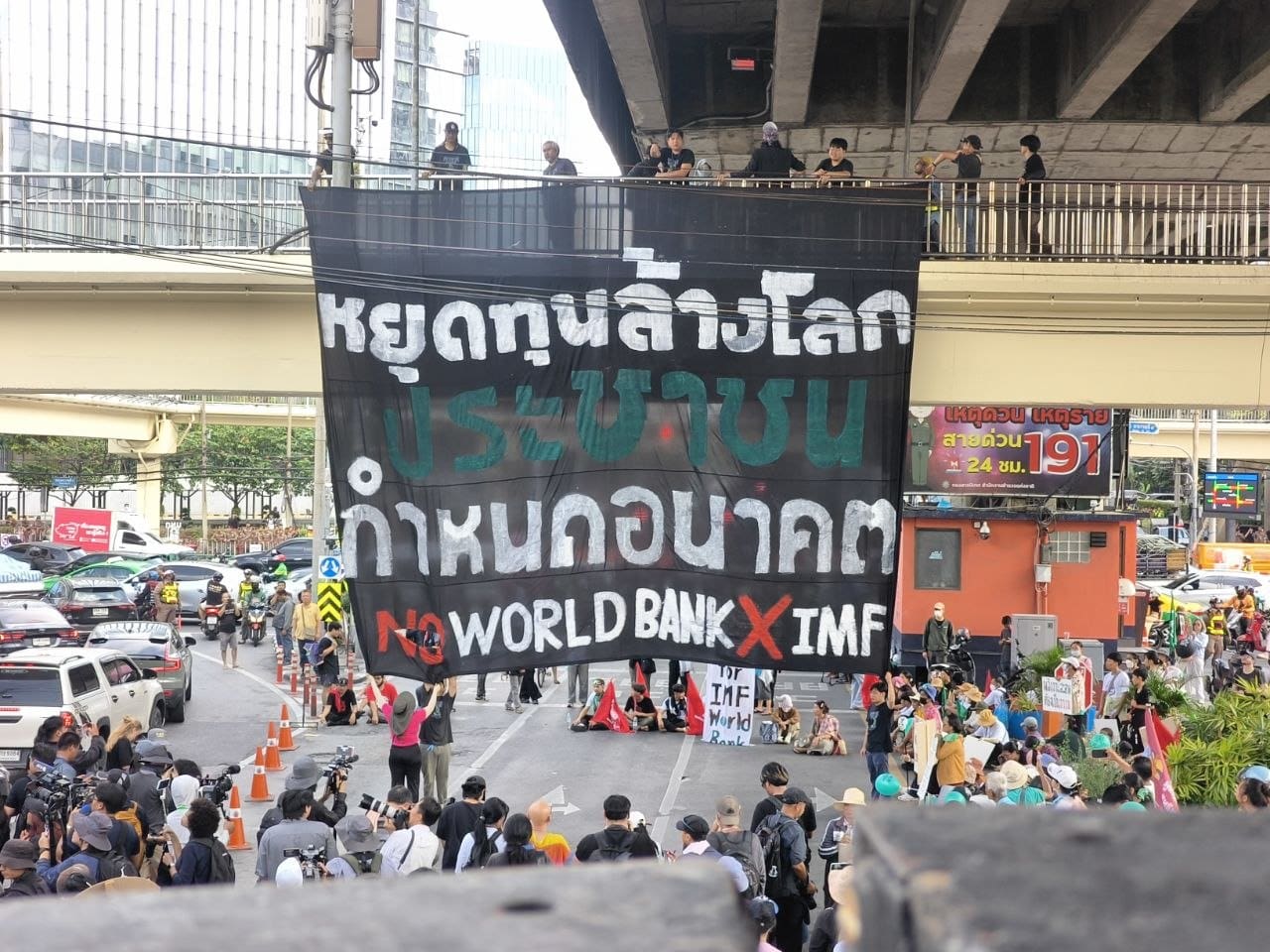
Occupy and Resist Capital That Destroys the Planet!
The People Must Determine Their Own Future!
Statement of the People’s Network Against the World Bank and IMF – 15 October 2026
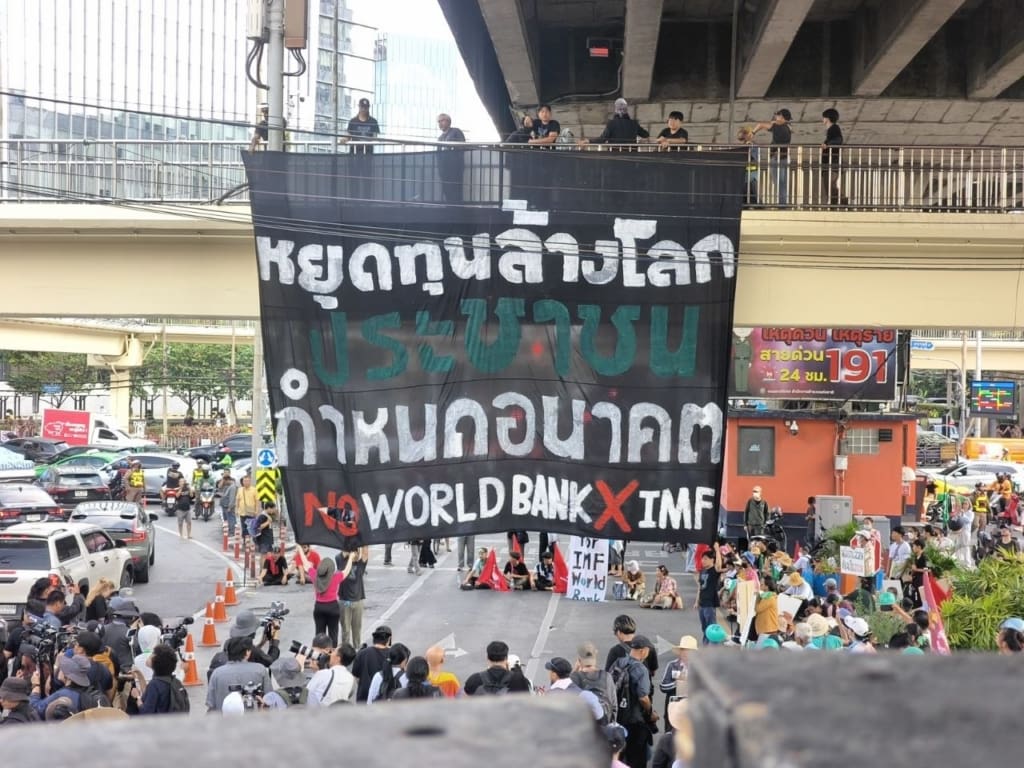
We are the People’s Network Against the World Bank and IMF—a nationwide movement of farmers, workers, women, the urban poor, Indigenous Peoples and ethnic communities, and communities defending human rights, nature and the environment.
Today, we have come together to occupy this space and resist a development order that creates wealth for capital and the ruling elites, while leaving the people to bear the burden of debt, environmental destruction, and losses paid for with their lives and futures.
Although our struggles take place in different parts of the country, we confront the same structures of power: neoliberalism, which places capital above people’s lives, and imperialism, which allows powerful nations to dictate the rules of the global economy.
The World Bank and IMF exercise this power through loans, policy conditionalities, and ideological domination, paving the way for capital to accumulate wealth while countries of the Global South and communities bearing the consequences are denied the power to make decisions.
We are not here to accept the rules imposed by capital. We are here to reclaim our power to determine our own future, including the right to reject development that destroys lives, nature, and the environment.
The World Bank and IMF Annual Meetings in Bangkok, held from 12 to 18 October 2026, mark the return of financial institutions that have yet to take responsibility for the damage caused by their past policies and development projects.
This so-called “Financial Olympics” has become a stage where states and capital come together to determine the future of the global economy, even as ordinary people continue to pay the price for past destruction.
This is not progress. It is the reproduction of capital’s wealth at the expense of people’s lives and livelihoods.
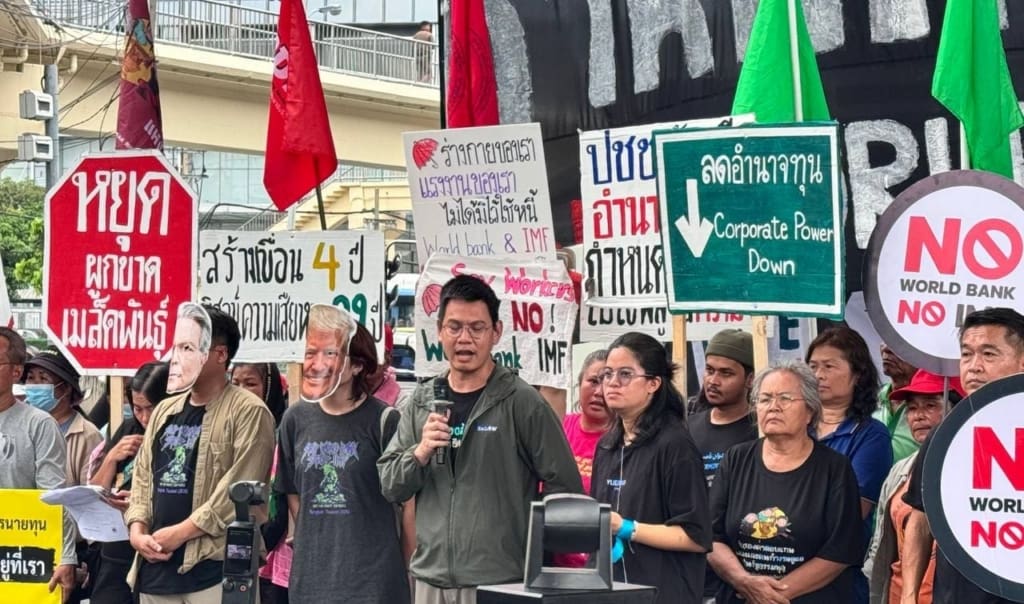
International capital does not dominate this country on its own. The structures of the Thai state have taken up and actively enforced this economic order through what we call the “Blue Regime”—a system that brings together powerful business interests, entrenched political dynasties, state institutions, so-called independent bodies, and extraordinary powers to preserve economic and political control in the hands of the ruling elites.
When capital demands land, resources, and investment projects, the state readily clears the way. Yet when people rise to defend their land, rivers, and forests, and demand accountability, the state invokes “the country’s image,” “national security,” and “public order” to suppress their rights and freedoms.
A regime that opens its doors for capital to plunder the country’s wealth while silencing those who defend their own communities cannot claim to govern in the interests of the people. It is a regime that uses state power to serve the accumulation of capital.
Over the past several weeks, state officials have subjected people to surveillance, intimidation, and harassment at their homes and workplaces, placing pressure on families and community leaders. This intimidation forced a public forum in Patani to move online. There has also been a death threat against a human rights defender, which the state must independently investigate and ensure that those responsible are held accountable.
While the ruling elites and financial institutions sit in luxurious conference halls deciding the country’s future, the people who stand up to defend their homes and communities are subjected to threats and intimidation.
The state opens its doors to welcome capital, while using its power to silence the people.
This is not the maintenance of public order. It is the use of state power to protect the interests of capital.
There can be no legitimacy whatsoever in using fear to strip the people of their rights and freedoms!
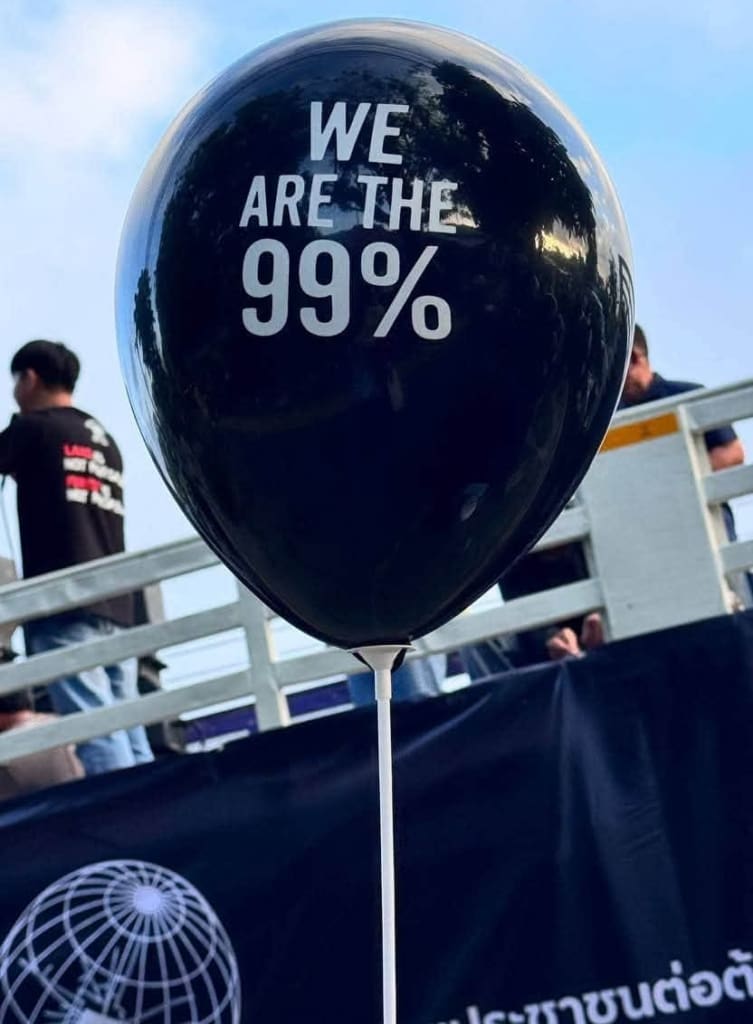
Photo credit: Thai NGO Coordinating Committee on Development
Over the past three days, amid wars, energy crises, and mounting debt, the World Bank and IMF have continued to promote economic growth as their overriding objective. Yet they fail to answer the fundamental questions: Growth for whom? And who controls the wealth it creates? Just 32 countries account for 95 percent of global economic growth, while the majority of people continue to struggle with poverty and debt.
For decades, the World Bank and IMF have exercised their domination not only through loans and policy conditionalities, but also through the power to shape economic thinking. Governments have been led to accept liberalisation, cuts to social welfare, and the expansion of opportunities for capital as the very definition of progress, with GDP serving as the measure of success. But rising GDP does not mean fair wages, access to farmland, secure housing, or the preservation of nature and the environment that sustain people’s lives.
An economy that counts the profits of capital fails to recognise the care work that sustains life and keeps the economy running—particularly the low-paid and unpaid labour of women. Yet care should be a collective responsibility of the state and society. This is an economy that counts profits but fails to recognise the value of people’s lives.
Under an economic order that places growth and capital accumulation above all else, rivers, forests, mountains, and seas—which have sustained people’s food systems, livelihoods, cultures, and ways of life for generations—are reduced to mere “assets” to be priced, concessioned, and exploited for profit.
The construction of dams, the opening of mines, land reclamation from the sea, and the building of power plants are recorded as investment and economic growth. Yet the destruction of river ecosystems, the loss of forests, the degradation of marine environments, and the displacement of communities are never recorded as debts that investors and decision-makers must repay.
This is a development order that treats the profits of capital as progress, while turning environmental destruction and the suffering of communities into costs for which no one is held accountable.
Today, the World Bank continues to advance Private Capital Mobilisation, reporting that it mobilised as much as US$112 billion in fiscal year 2026. Yet the overwhelming share of this capital has been concentrated in upper-middle-income countries, while low-income countries received only approximately US$3 billion.
This approach exposes a fundamental contradiction at the heart of the neoliberal economic order. While proclaiming that markets and private capital should drive development, it relies on public money and resources to guarantee investments and reduce risks for private investors.
This is “neoliberalism subsidised by public money”—an arrangement that allows private capital to choose investments that generate profits, while states and ordinary people are left to bear the risks of debt, taxation, and damage to shared resources.
In other words, profits are privatised, while risks and losses are shifted onto the people.
The injustices produced by this development order are not confined to economic reports or academic critiques. They are lived as deep wounds in the lives of communities across Thailand.
The experiences of the Pak Mun Dam, Bang Lang Dam, and potash mining bear witness to a model of development that has deprived people of their land, rivers, food sources, livelihoods, and ways of life passed down through generations.
The urban poor and railway-side communities face eviction and housing insecurity to make way for urban development driven by the demands of capital. Meanwhile, communities in eastern Thailand confront both devastating floods and industrial pollution, threatening their health, food sources, and livelihoods.
This is development that creates wealth for a privileged few by stripping ordinary people of the very foundations of their lives and their access to resources.
The floodwaters may have receded, but the debts, toxic contamination, and damage to people’s lives have not washed away with them.
The dams may have been completed, but the rivers and the ways of life they destroyed have yet to recover.
The mines generate profits for capital, but leave communities with degraded land and polluted water.
These damages are not the price that people must pay for progress. They are debts that the state, the World Bank, and corporate interests must take responsibility for—through ecological restoration, remedy, reparations, and compensation.
The people have already been forced to sacrifice far too much of their lives and the natural world.
The people do not owe the World Bank. It is the World Bank that owes the people a debt of justice!
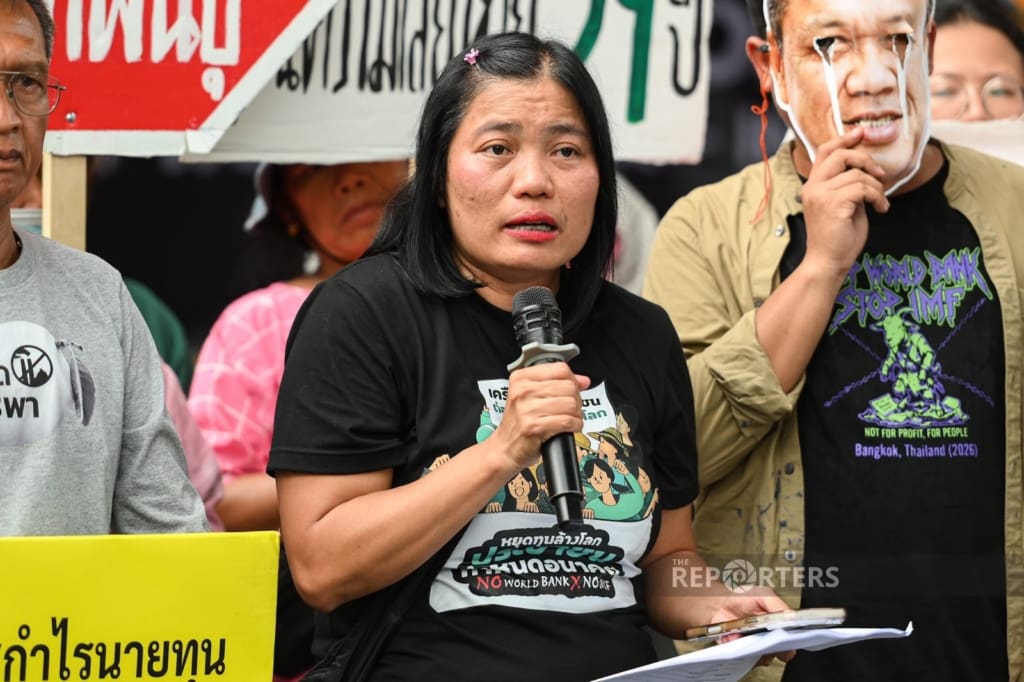
Pranom Somwong, representative for Protection International in Thailand.
Photo credit: Reporters Thailand.
The Positions and Demands of the People’s Network Against the World Bank and IMF
The People’s Network Against the World Bank and IMF hereby declares its seven positions and demands:
- Return the Power to Determine the Future to the People, Not the State and Capital: People must have the power to make decisions and to reject policies or projects that destroy their lives and resources. Public consultations conducted only after the state and capital have already made their decisions are not genuine participation. They are merely rituals designed to legitimise the power of those who rule.
- Energy Must Belong to the People, Not Serve as a Source of Profits for Capital: End the use of public money to subsidise monopolistic energy corporations while passing the costs on to ordinary people through their electricity bills. The energy transition must do more than simply replace one type of fuel with another. It must transform the structures of ownership and power, enabling people and communities to own, manage, and benefit fairly from energy resources and systems.
- Stop Accumulating Public Debt to Create Wealth for Capital: End public borrowing and investment guarantees for projects over which people have no decision-making power. Disclose all loan agreements and their conditions. Reject the privatisation of public assets and liberalisation policies that favour corporate interests. Debt is a new form of colonialism, through which loans are used to impose policies and shift the burden of repayment onto the people, while capital reaps the benefits. We demand the cancellation of illegitimate debt and an end to the use of debt as an instrument for dominating the people’s economic sovereignty.
- Social Welfare Is a Right, and Care Work Is the Work That Sustains Life: The state must provide universal social protection and public services, and recognise the rights and fair compensation of both paid and unpaid care workers. Care work is labour that creates and sustains life, nurtures society, and makes the functioning of the economy possible. End the dismantling of social welfare to increase corporate profits, while shifting the responsibility for sustaining and caring for human life onto women and families alone.
- Those Responsible for Destruction Must Pay, Not Leave the People to Bear the Consequences: The World Bank, IMF, governments, and corporate interests involved must be held accountable for the harm caused by their policies and development projects. They must disclose information, submit to independent scrutiny, restore damaged natural resources and ecosystems, and provide fair remedies, reparations, and compensation to affected communities.
- End the Intimidation of the People. The Right to Peaceful Assembly Is Not a Privilege That the State Can Grant or Revoke at Will: Immediately end surveillance, threats, intimidation, and obstruction targeting communities and human rights defenders, including restrictions on academic freedom in universities. Peaceful assembly is a fundamental right of the people, not something the state may arbitrarily restrict at its discretion. The state has a duty to facilitate and protect peaceful assemblies, not to invoke national security powers to silence dissent. Those in positions of command must be held accountable for the actions of their subordinates, and the violence witnessed during the 2022 APEC protests must never be repeated.
- Dismantle the Economic Structures That Serve Capital and Break the Monopoly of Power Under the Blue Regime: Thailand’s 14th National Economic and Social Development Plan must not become another instrument enabling corporate monopolies to control the country’s resources and future. Power and wealth must be redistributed. The rights of people and communities to govern and manage their land, water, forests, seas, and energy resources must be restored.
The struggle against the Blue Regime is a struggle against the intertwined structures of state power and capital that monopolise wealth and determine the destiny of the people.
We Occupy This Space in Civil Disobedience The Streets Are the People’s Parliament!
Nonviolent Direct Action Is Love Put into Action to Make Justice a Reality!
The Future Is Not Something the State and Capital Can Bestow Upon Us
It Is Ours to Create!
People’s Network Against the World Bank and IMF